How AI Invoice Fraud Detection Works
by Hannah Khouri
A new study found that four in 10 organizations have experienced invoice fraud or overpayment in the past year. While AI has increased the prevalence and sophistication of fraud tactics, it’s also one of the most effective ways to prevent them. AI invoice fraud detection analyzes patterns across invoice data, vendor history, and payment behavior to flag anomalies before payments are approved.
As invoice volume grows and fraud tactics continue to evolve, human-powered controls can no longer keep up. Seemingly minor issues like subtle price increases, duplicate submissions, and unusual vendor activity can easily fly under the radar…until it’s too late. Across thousands of invoices, the financial damage adds up quickly.
In this post, we’ll take a deep dive into how AI detects invoice fraud and price anomalies in real time and how AP teams are using it to maintain control at scale without slowing operations down.
Why is invoice fraud so hard to catch?
Preventing invoice fraud is one of those things that sounds so simple in theory. But it’s actually a lot more complicated than it seems. Why? Because fraud tactics are getting harder to detect, and the controls many organizations rely on aren’t keeping up.
Invoice fraud doesn’t usually show up as an obvious red flag. It’s usually something much more subtle that can easily blend into normal, day-to-day operations without raising any concerns. For example, fraud can sneak in as a unit price that’s just a little higher than normal. Or it could be a duplicate invoice submitted under a different number.
Outdated AP processes are a big part of the problem. Many teams still rely on a combination of spreadsheets, email approvals, and disconnected systems, an approach that exposes vulnerabilities to fraudsters. What’s more, when different parts of the AP process live in different places, visibility is limited, and it’s difficult to notice patterns or connect subtle anomalies that may signal fraud.
At the same time, accounts payable fraud tactics are evolving every day. Vendor impersonation, invoice manipulation, duplicate billing, unauthorized vendor changes, and employee collusion have all gotten more common…and increasingly hard to detect.
AP fraud prevention isn’t as simple as stopping a single bad invoice before it’s processed and paid. Today’s AP teams must be able to spot patterns and subtle shifts at scale. But without a way to analyze behavior across invoices, vendors, and payments, even the best AP teams can miss issues until the damage has been done.
Why aren’t manual reviews enough?
By now, most finance teams are aware of the growing risk of invoice fraud and have put measures in place to prevent it. According to recent research, manual reviews are the most common prevention tactic.
Manual reviews might seem “good enough” when a finance team is dealing with a small volume of invoices. But this human-powered control isn’t built to scale.
Even as invoice volume grows, many teams are expected to continue operating at the same speed. As a result, invoices aren’t scrutinized as much as they should be, and it’s easy for issues to slip through the cracks.
At the same time, reviewing thousands of invoices each month is tedious, repetitive work that requires close, sustained attention to detail. When cognitive fatigue sets in, especially when there’s a time crunch, even the most experienced reviewers can overlook subtle inconsistencies.
When AP is managed across spreadsheets, emails, and disconnected systems, it’s hard to connect the dots. Teams have no way to effectively analyze behaviors across invoices, vendors, and payment history, so issues remain hidden until the damage is done.
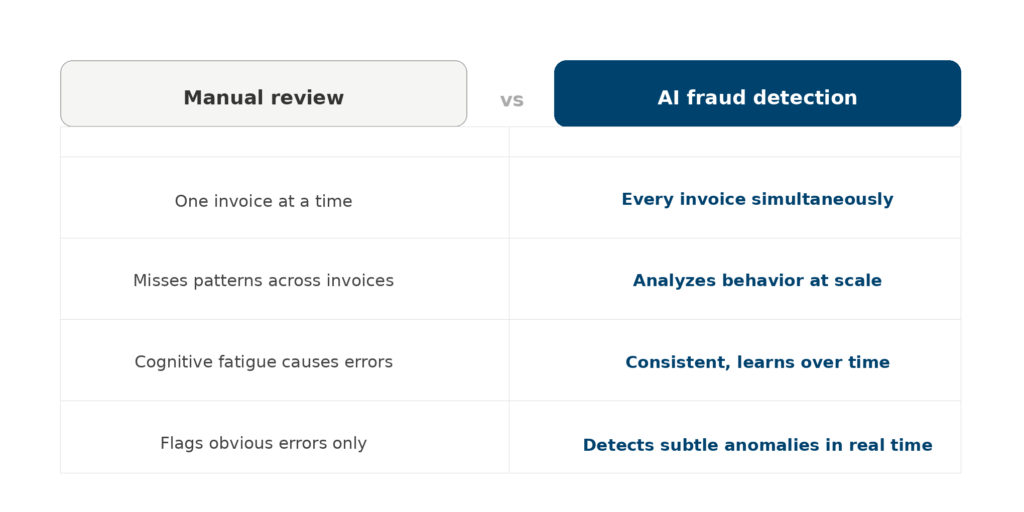
Manual checks leave significant gaps. Fortunately, AI is built to fill them.
How does AI invoice fraud detection catch fraud and price anomalies?
AI invoice fraud detection works by analyzing large volumes of invoice data, vendor history, and payment behavior to flag patterns that suggest risk.
Even the most skilled AP employees can only review one invoice at a time. AI, on the other hand, can evaluate every transaction in the context of everything that came before it. That means it notices anomalies that could easily be overlooked in manual reviews.
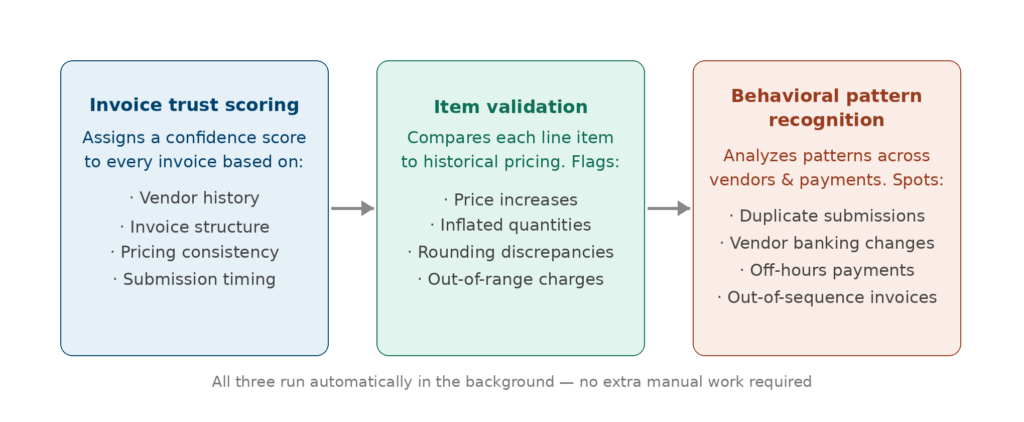
There are three major components of AI invoice fraud detection. Let’s take a closer look at how each one works.
Invoice trust scoring
Invoice trust scoring uses AI to calculate a confidence score for every invoice based on factors including:
- Vendor history
- Invoice structure
- Pricing consistency
- Timing
Invoices from known, trusted vendors with consistent pricing and typical submission timing receive higher scores and can flow through the process smoothly. Invoices submitted from unknown vendors with unexpected pricing or submission patterns receive lower trust scores and are flagged for additional human review.
Not all invoices carry the same risk. But when AP teams are juggling hundreds or thousands of invoices, it can be tough to determine which ones need more oversight. Invoice scores help them understand where to focus their efforts.
Item validation
Item validation is focused on the line-item level of invoices, where pricing issues and fraud tactics often slip through. During the process, AI compares each line item to historical pricing data and expected cost ranges to identify inconsistencies.
Through item validation, AI can detect price anomalies, including gradual price increases, inflated quantities, rounding discrepancies, or charges that fall outside of normal thresholds. These likely wouldn’t raise concerns in isolation, but with AI, they can be flagged in real time.
AI-powered item validation runs automatically in the background, giving AP teams more control – no extra manual work required.
Behavioral pattern recognition
AI analyzes behavioral patterns across vendors, payments, and approval workflows to identify activity that falls outside of what’s considered “normal.” This includes duplicate invoices with subtle variations, out-of-sequence invoice numbers, changes to vendor banking details, or payments initiated outside typical business hours.
AI continuously learns what “normal” looks like for each vendor and organization, making it easier to detect suspicious behavior as it occurs. Pattern recognition also gets more accurate over time, which means teams can detect even the most subtle anomalies before it’s too late.
What happens when AI flags a suspicious invoice?
Once AI flags a suspicious invoice, it’s typically sent to a centralized human review queue, along with clear reasons for the alert. This could be anything from a low trust score to a line-item pricing issue to unusual submission behavior. When teams have the right context, they can quickly hone in on what needs their attention.
From there, AP teams typically take one of three actions based on the company’s established policies and processes.
- Approve the invoice: If a flagged discrepancy is expected and deemed not to be a cause for concern.
- Reject the invoice: If a discrepancy proves problematic and the invoice is risky.
- Escalated: If the invoice needs further review before making a judgment call.
Human judgment is front and center during the entire review process. AI never acts as a replacement for human finance teams. It simply helps them understand how to prioritize and where to focus.
During the review process, everything is automatically documented, which creates a clear audit trail. Approvals, rejections, changes, and comments are all captured in real time, making internal reviews and external audits much less painful.
Some organizations also layer on threshold-based and role-based approvals to further strengthen control. At those organizations, higher-risk invoices may require additional approvals, while lower-risk transactions flow through the system uninterrupted.
The bottom line is that work doesn’t stop once an invoice is flagged as suspicious. But by using AI, teams can effectively manage risk at scale without slowing down operations.
Beyond detection: securing the full payment cycle
Detecting fraud prior to payment is critical, but it’s just one piece of the puzzle. To truly protect against financial risk, AP teams must work to secure the entire payment cycle, from initial invoice intake to disbursement.
Why does this matter?
Because even if an invoice is properly approved and validated, vulnerabilities during the payment stage can introduce risk. For example, compromised vendor banking details, intercepted payment information, and unauthorized changes to payment methods can lead to fraud, even after initial checks are completed.
But what exactly can AP teams do to maintain control across the entire payment cycle?
Secure disbursement methods are an important layer of defense. For example, single-use virtual cards reduce the risk of payment data being intercepted, while controlled ACH workflows add guardrails to outbound payments. Solutions like VendorPay from Ottimate bring these capabilities together into a single platform that enables AP teams to securely manage payments.
An effective risk mitigation approach requires both layers. AI invoice fraud detection flags suspicious activity before approval, and secure AP payment methods provide protection during disbursement. Together, these controls offer powerful protection for companies looking to reduce risk across the payment lifecycle, without causing delays or adding more complexity.
Best practices to get the most out of AI invoice fraud detection
AI can be a powerful tool for detecting invoice fraud and price anomalies. With some simple best practices, AI invoice fraud detection can be even more accurate and effective.
1. Keep vendor records accurate and up-to-date
Outdated or inaccurate vendor data makes it nearly impossible for AI to identify accurate patterns. Regularly review vendor details, including banking information and contact records. It’ll improve accuracy and decrease false positives.
2. Maintain strong access controls across AP systems
Not all users should have the same access to AP systems, and passwords should never be passed around. Instead, create role-based permissions to ensure the right users have access to the right information and capabilities – no more and no less.
3. Set appropriate approval thresholds
Not all invoices carry the same risk. Establish approval workflows based on dollar amount, vendor type, and location. Higher-risk transactions are subject to additional signoffs, while routine, low-risk approvals can flow through uninterrupted.
4. Review flagged invoices promptly
When flagged invoices sit in queues for too long, it causes payment bottlenecks and missed opportunities to prevent fraud prior to payment.
5. Use audit trail data proactively
Don’t wait for an audit to roll around before reviewing your activity logs. Instead, take a proactive approach. Regularly analyze audit trails to identify patterns, process gaps, or recurring anomalies before they grow into bigger problems.
Frequently asked questions about AI invoice fraud detection
How does AI detect duplicate invoices?
AI detects duplicate invoices by comparing invoice numbers, amounts, dates, and vendor details across historical records. It can also detect invoices with subtle variations in numbering or formatting, which are often missed during manual reviews.
What is Invoice Trust Scoring?
Invoice Trust Scoring uses AI to assign a confidence score to every incoming invoice based on historic activity, invoice structure, pricing consistency, and timing. Invoices from known vendors with predictable formats, pricing, and timing are assigned high scores, while those from unknown vendors with unexpected pricing and behavior receive lower scores. Invoice Trust Scores can help teams understand which invoices need closer review prior to payment.
Can AI catch price anomalies on small invoices?
Yes, AI can detect price anomalies on invoices of all sizes. It does this by analyzing line-item detail against historical pricing trends and expected ranges. AI can even detect small or gradual price increases that may seem insignificant in isolation, but can quickly add up to measurable financial loss.
How is AI invoice fraud detection different from manual review?
Manual reviews focus on one invoice at a time, which makes it nearly impossible to spot meaningful patterns. AI invoice fraud detection, on the other hand, analyzes every invoice in context, which means it can spot anomalies across vendors, pricing, and behavior in real time, at scale.
Does Ottimate’s fraud detection work across multiple locations?
Yes, Ottimate’s AI invoice fraud detection analyzes data across multiple locations to identify patterns and inconsistencies at scale. This is especially valuable for businesses with distributed operations, where risks such as duplicate invoices and pricing can occur across different sites.
It’s time to stop AP fraud in its tracks
Invoice fraud isn’t something finance teams can afford to ignore. This rise of AI is making it more prevalent, more sophisticated, and much harder to detect.
Today, fraud rarely announces itself as an obvious error. More often, it shows up as a subtle pattern, minor inconsistency, or unexpected behavior that can easily be missed during manual reviews. This is especially true for teams that handle hundreds or thousands of invoices every month.
Increasingly, teams are turning to AI to close the gaps left by manual reviews. AI invoice fraud detection analyzes data at scale, identifies anomalies in real time, and flags risks before payment goes out. Teams can maintain control and stop AP fraud in its tracks, without slowing down operations.
Curious how these controls work in practice? Watch our AP fraud webinar for practical tips on detecting and stopping fraud.
Ready to see what AI invoice fraud detection can look like in your AP environment?
Schedule a demo to see Ottimate in action.