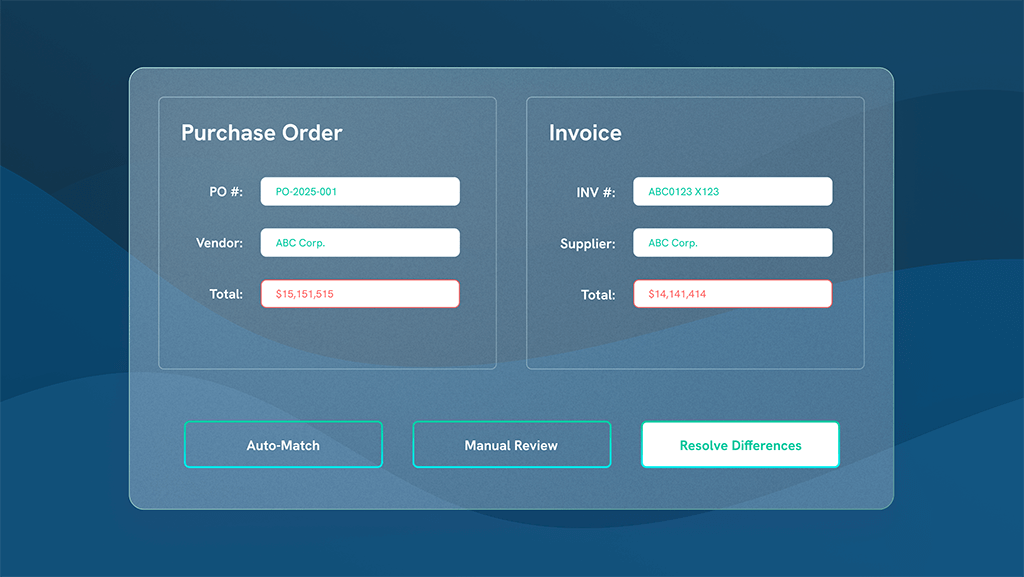
The Secret to Strong Accounts Payable Data Integrity
by Hannah Khouri
There’s an old adage that “the numbers don’t lie.” But in the world of accounts payable (AP), that’s not always true.
Many finance teams don’t trust their own numbers. And truthfully, that distrust is often well-founded. Manual data entry, disconnected systems, and spotty audit trails are still common at many organizations. This state of chaos leads to messy, conflicting data that makes it nearly impossible to maintain accounts payable data integrity and make confident financial decisions
But the good news is that this chaos isn’t inevitable. By building structured, automated processes that connect every PO, invoice, and receipt, your team can regain trust in its data for once and for all.
In this post, we’ll explore why so many finance teams lose confidence in their numbers, what happens when accounts payable data integrity breaks down, and how to improve AP data accuracy across every stage of your process.
Why it’s hard to trust your own AP numbers
Finance is a numbers business. But if you’ve ever found yourself questioning the integrity of your own numbers, you’re not alone.
Teams lose trust in their AP data for a variety of reasons. But there are some common culprits that undermine accounts payable data integrity again and again.
Manual work and data entry
Many AP teams still key in invoice data by hand and manually match invoices to POs and receipts. With any manual process, errors are inevitable. Duplicate entries, data inconsistencies, and missed updates slowly (but surely) chip away at your accounts payable data integrity.
Disconnected systems
Finance teams rely on multiple platforms to get work done, including ERPs, POS systems, and invoice management tools. Often, these systems don’t talk to each other, which leads to conflicting data. For example, one system may say an invoice is paid, while another says it’s pending resulting in late payments and extra fees.
Chaotic reconciliation
When purchase orders and receipts are delayed or missing, the invoice reconciliation process becomes a guessing game. Teams waste valuable hours hunting for missing information and double-checking mismatched details just so they can close the books. It’s frustrating, inefficient, and it ultimately damages your accounts payable data integrity.
The hidden costs of poor accounts payable data integrity
Many finance teams don’t fully trust their own data. But the biggest mistake is accepting that distrust as an unavoidable reality. About 39% of invoices contain errors, and Ardent Partners research puts invoice error rates at 15–20%.
Why? Because poor accounts payable data integrity has far-reaching consequences across the entire business. Here are a few that rise to the top.
Strained vendor relationships
When numbers don’t match up, vendor disputes are inevitable. Each discrepancy takes staff time and effort to resolve.
Over time, this back-and-forth can strain vendor relationships, damage credibility, and lead to less favorable pricing or terms. In some cases, vendors may deprioritize your work or stop working with your business altogether. This can leave you scrambling to secure the supplies and services needed to run your business smoothly.
Slower month-end close cycles
While closing the books should be straightforward, it often isn’t. In fact, recent research found that over half of finance teams spend six days or more closing the AP books each month.
When your AP data is unreliable, your team must scramble each month to reconcile discrepancies and verify every number. This leads to a slower month-end close and lingering doubts about the accuracy of your data.
Increased audit risk
Audits are never fun for finance teams. But when accounts payable data lacks structure and consistency, they become an even bigger pain.
Missing documentation, mismatched records, and unclear approval trails can all raise red flags for auditors. Without clear connection between invoices, POs, and receipts, it’s hard to prove compliance or verify transactions. This can lead to greater exposure to errors, audit delays, and financial penalties, all of which undermine confidence in your financial reporting.
If you don’t trust your AP data, it doesn’t have to stay that way. Rebuilding that trust starts with ensuring there’s a consistent story across invoices, purchase orders, and receipts.
How to rebuild accounts payable data integrity
Many finance teams struggle with accounts payable data integrity. Yet, they stay stuck because the problem seems so big and they’re not sure how to start tackling it.
Fortunately, there’s a clear, practical path forward, and it all starts with building consistency in your AP tools and your processes. When every invoice, purchase order, and receipt follows the same structured path, accuracy becomes the norm rather than the exception.
This approach is known as structured validation. Essentially, it’s a repeatable, rules-based process that verifies every transaction before it moves forward. Structured validation ensures invoices, POs, and receipts align at every step of the process, and it catches discrepancies before they turn into costly errors.
Structured validation doesn’t add extra work. In fact, it does the opposite by baking accuracy into every step of your workflow. Accuracy isn’t an afterthought. It’s part of the process.
Here is what structured validation looks like in practice.
Digitized POs and receipts for consistent recordkeeping
When finance teams rely on paper files or email attachments, documents are bound to get lost in the shuffle. Digitizing purchase orders and receipts means that every record lives in one place, is formatted consistently, and is ready for quick verification.
AI-powered technology makes things even easier. AP teams can use AI to automatically read and code all line items on an invoice, and then match each one to the corresponding PO on record. This builds structured validation into the workflow and provides a complete, audit-ready trail that’s available whenever you need it.
Automated approval paths for accountability
Manual approval processes are slow and error-prone. Plus, there’s no clear visibility into where an invoice stands and what needs to happen next.
By standardizing and automating approval workflows, finance teams can make sure every invoice goes to the right people at the right time. This speeds up approvals and builds trust and ownership into the process.
Invoice-matching logic to verify accuracy before payment
Two- or three-way invoice matching, a key part of PO matching in accounts payable, compares invoices against their corresponding POs and receipts before payment goes out the door. Here’s 2-way and 3-way matching explained in simple terms:
- 2-way matching verifies that the invoice matches the purchase order
- 3-way matching adds an additional layer by confirming the receipt matches the invoice and purchase order
This structured approach catches discrepancies right away, reduces errors, and prevents overpayment. More importantly, it increases confidence in each and every transaction.
Structured validation isn’t about adding layers of control just for the sake of control. Instead, it’s about creating clarity and trust. With structured validation, finance teams can be confident that every number tells the same story, no matter where it lives. Teams can then use this data to fuel impactful decisions.
The ripple effect of strong accounts payable data integrity
When your accounts payable data is accurate, everything else starts to run more smoothly. Sure, clean, reliable data simplifies your processes. But more importantly, it transforms relationships and enables better decisions that move your business forward.
Stronger supplier relationships
When you consistently make on-time, accurate payments, your vendors take notice. That consistency will build trust, which gives you more leverage for favorable terms, faster resolutions, and stronger working relationships.
Faster, more accurate closes
When invoices, POs, and receipts are aligned throughout the process, month-end close is a breeze. You can close the books faster and with higher accuracy. And, your team can spend less time chasing down discrepancies and more time analyzing results and delivering proactive, actionable insights.
Improved audit readiness
With structured, validated data, every transaction has a clear trail of documentation. This transparency gives auditors confidence, saves your team hours of prep, and moves you closer to truly audit-ready accounts payable. You can prove accuracy at a moment’s notice – no scrambling required.
Confidence that carries across the business
Dependable data creates a ripple effect that reaches far beyond the AP team. Finance leaders can forecast more accurately, operations teams can plan with confidence, and company leadership can make impactful decisions based on reliable, real-time data.
Here’s the bottom line: when your accounts payable data is accurate, everything else starts to run more smoothly.
Reliable AP data starts with reliable processes
Let’s face it: finance teams can’t make confident decisions when they’re constantly questioning the validity of their AP data. But accepting that doubt as inevitable is a bad move.
Absolute confidence starts with building structured, consistent AP processes that keep every invoice, PO, and receipt aligned every step of the way.
Strengthening your accounts payable data integrity isn’t just about fixing errors. It’s about building a foundation of trust that ripples across your entire organization. It improves collaboration, speeds decision-making, and enables leaders to make impactful, data-driven decisions.
With the right structure in place, you can finally move from chaos to control. Ready to take the next step? Book a live demo to see how Ottimate helps winning finance teams simplify matching, automate validation, and regain confidence in their AP data.