Inside the Modern AP Stack: Capture to Pay
by Hannah Khouri
In the past, accounts payable looked largely similar from one company to the next. Invoices arrived via mail, were manually keyed into the ledger, and routed for approval by hand. Fragmentation is the norm with no unified AP workflow automation.
Today, most finance teams are tapping into technology to lighten the AP load. In fact, a recent study found that 93% of organizations use automation tools in their AP workflows.
At first glance, this sounds like progress. But a deeper dive into the data reveals that just 4% have fully automated AP. That means the vast majority are operating with fragmented tools and processes. They rely on different systems to handle different parts of the workflow, and manual work is still needed to move data, context, and approvals from one step to the next.
Investing in another point solution might promise to ease the pain. But all too often, it just introduces another handoff.
AP teams face no shortage of challenges. Solving them requires a connected AP workflow, not a growing collection of disjointed tools. Read on to explore why a fragmented approach fails and how finance teams can start building a truly modern, unified approach to accounts payable.
Why more AP tools don’t equal better AP
AP teams encounter a number of daily frustrations, and there are plenty of tools that promise to eliminate them.
But in the world of finance, more tools doesn’t necessarily mean better AP.
Sure, a point solution may address a single problem. For instance, an invoice capture tool can eliminate the need to manually key every invoice. But every tool that’s added to the AP tech stack introduces yet another handoff. And when AP tools don’t play nice together (which is often the case), those handoffs aren’t exactly smooth.
Fragmented tools lead to manual reentry, lost context, and confusion on where invoices stand and what needs to happen next. As a result, AP teams are forced to become workflow managers, coordinating tools and status updates rather than focusing on higher-value work.
What “modern AP” really means today
Many finance leaders consider their AP operations to be “modernized.” But often, the definition of “modern” stops at surface-level improvements like shifting to digital invoices or adopting an optical character recognition (OCR) that digitizes intake but doesn’t touch the rest of the workflow.
These initiatives chip away at an isolated piece of the problem. But true modernization goes beyond digitization and faster payments.
Modern AP means:
- End-to-end visibility: Teams always know where an invoice stands, and finance leaders have real-time access to the data needed to make impactful decisions.
- Fewer handoffs: Efficient invoice processing doesn’t require jumping from one siloed tool to another.
- Intelligent automation across the full lifecycle: The process is hands-off from invoice capture to payment, with automation working continuously rather than in isolated steps.
Fragmented, bloated AP stacks don’t deliver these outcomes.
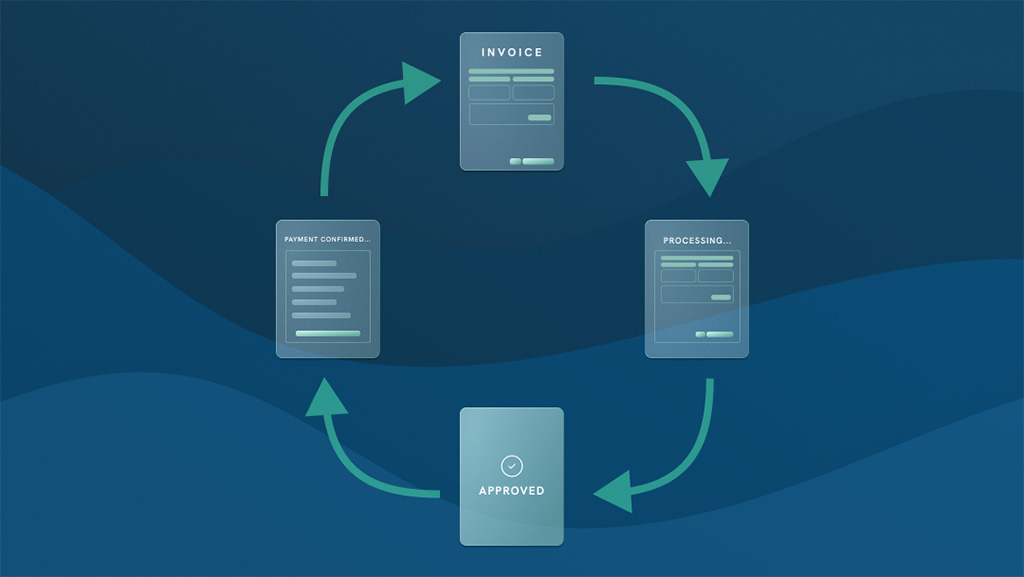
To see a real impact, organizations must rethink modern AP as a capture-to-pay workflow that operates as one unified system, rather than a series of disconnected point solutions.
The invoice-to-payment lifecycle: where fragmentation breaks down
To truly understand why a fragmented AP stack fails, it’s helpful to look at the invoice-to-payment lifecycle step-by-step.
In theory, each step of the process seems straightforward. But breakdowns between the steps (caused by disconnected tools) turn routine work into a constant stream of delays, errors, and rework.
Invoice capture: where fragmentation starts
According to recent research, more than half of organizations process 5,000 or more invoices each month. These invoices come in a wide range of formats and from a variety of sources.
Because invoice capture is the start of the process, it’s important to get it right. But while standalone capture tools are built to digitize invoices, they don’t support what happens next.
Poor accuracy and lack of context are common, and they lead to problems that must be corrected later in the process. So while data might look good enough at intake, it requires manual intervention during coding, approvals, or payment.
In a unified workflow, invoice capture is the entry point of a connected process. Invoice data is structured in a way that supports the full lifecycle. That means work continues to flow forward rather than getting stuck at a handoff.
Coding, validation, and matching: where problems get more complicated
Many problems start at invoice intake. But the next stage of the AP process is where these issues get a lot more complicated.
GL coding, cost allocation, and PO vs non-PO handling all depend on accurate data and clear context. But in fragmented AP stacks, that context often gets lost after intake. Data captured in one system must be reinterpreted by another, and AP teams are forced to re-code invoices, re-check details, and resolve discrepancies that could have been addressed earlier.
Matching is another area where the gaps of disjointed systems become obvious. When purchase orders, receipts, and invoices live in different systems, mismatches become exceptions. And investigating each one can feel like a wild goose chase.
In a unified capture-to-pay workflow, coding, validation, and matching are all connected. Each process is informed by the same, shared data and guardrails across the entire lifecycle. The result is that invoices flow through the process automatically and exceptions are only flagged when they truly require human intervention.
Approvals and exception handling: where momentum breaks down
More than half of finance professionals feel their approval workflows don’t perform well. But people are rarely the reason behind the problem; it’s the disconnected systems.
In fragmented workflows, approvals get lost in inboxes or are routed without full context. Approvers must ask questions to get clarity, which delays decisions and holds up invoices. Exceptions pile up as invoices move between disconnected tools, and AP teams waste countless hours hunting down approvals.
In a unified capture-to-pay workflow, approvals and exceptions are housed in the same system as invoice data, rules, and history. Invoices always have the full context, which means they can flow through the approval process faster. And exceptions only happen when human judgement is required.
Payments and reconciliation: where risk surfaces
Oftentimes, payments are treated as a separate function from invoice processing. But when payment execution is disconnected from invoice data, it creates risk.
With a fragmented approach, payment systems don’t have full visibility into invoice status, approvals, and exceptions. This opens the door to duplicated and missed payments and limits insight into cash timing.
Furthermore, reconciliation becomes reactive instead of automatic. Teams must spend time on manual checks and making corrections when things are amiss.
In a unified capture-to-pay workflow, payments are executed with full invoice context, and reconciliation is built into the process. This reduces risk, increases control, and boosts finance teams’ confidence in their payables data.
Why fragmented AP tools fail as businesses scale
When a company is just starting out and its invoice volume is low, fragmented AP tools can seem manageable. But as invoice volume and organizational complexity grow, the gaps start to get more obvious.
More tools means more handoffs, and each one is an opportunity for risks, delays, and manual effort to sneak in. A seemingly small problem that happens early in the process can become a big problem further down the road. Avoidable errors get more common, exceptions spike, and AP teams get burned out by constantly babysitting clunky, disconnected workflows.
Layering automation on top of fragmented systems only speeds up the movement of inaccurate or inconsistent data. So instead of reducing work, fragmentation forces AP teams to step in even more often as scale increases.
But scalability doesn’t come from adding more tools to a clunky AP stack. First, teams must address the barriers that stand between them.
The power of a unified capture-to-pay workflow
A unified AP workflow trades disconnected steps for a single, integrated process. Invoices and data no longer bounce between tools, where rough handoffs introduce delays and risk. Instead, the entire invoice-to-pay lifecycle operates within a single, connected system.
When every stage of the process is connected, there are fewer handoffs and context flows alongside each invoice. That means data captured at intake informs every other step, including coding, validation, approvals, and payment. There’s no need to reenter data or worry about it being re-interpreted across multiple tools.
Unified AP workflows also impact how finance teams spend their time. Rather than constantly managing tools and workflows and chasing updates, teams can focus on the work that truly requires human judgement.
How Ottimate delivers capture-to-pay in one unified platform
Ottimate’s unified platform is built to manage the entire invoice-to-pay lifecycle in one connected workflow. Rather than cobbling together point solutions and worrying about rocky handoffs, it can handle everything from invoice capture to payment in one system that preserves data and context throughout the entire process.
Continuous invoice intelligence
Data collected at invoice capture informs everything that comes after, including coding, routing, approvals, and payment decisions. Over time, this shared intelligence reduces the need for manual corrections and ensures invoices continue to flow forward with minimal disruptions.
Built-in controls across the lifecycle
Controls are built into the entire AP workflow, not layered on after the fact. Policies are enforced consistently from intake to payment, automatically creating an audit-ready process that doesn’t depend on manual checks or disconnected systems.
Real-time visibility for AP and finance leaders
Every step of the AP workflow lives in one platform, so teams also have real-time insight into where invoices stand. AP teams can identify bottlenecks instantly, and finance leaders have complete, real-time visibility into liabilities and cash timing – no clunky spreadsheets or endless status emails needed.
What finance leaders must ask before adding another AP tool
When AP teams are struggling on a daily basis, the easy answer seems to be to invest in another tool to address their challenges. But before doing so, finance leaders must take a step back to ask some key questions, like:
- How many systems touch a single invoice from intake to payment?
- Where does context get lost as invoices jump between tools?
- How often do teams need to re-enter, re-check, or re-approve the same data?
- Can we see the full lifecycle in one place, or only in pieces?
- Are teams spending more time managing workflows or resolving true exceptions?
Often, the answers to these questions prove that a lack of automation isn’t the problem. It’s a lack of connection between systems. Adding another point solution may solve a single symptom, but it won’t address the root cause. In fact, it’ll add just another handoff point where data and context are lost.
Modern AP isn’t modular; it’s unified
Point solutions can address a single AP pain point. But they don’t solve the true underlying problem. Disconnected tools create disconnected workflows, and layering automation on top isn’t enough to overcome these fragmented systems.
Truly modern AP isn’t modular; it’s unified. When every step of the capture-to-pay lifecycle operates in one, unified workflow, invoices move faster, errors and rework decrease, and teams have more control over the entire process.
The path towards modern AP isn’t adding more siloed tools to a disconnected tech stack. It’s trading that fragmented stack for a unified capture-to-pay workflow that’s built to scale as your business grows.
Ready to trade the chaos of a fragmented AP stack for a unified capture-to-pay workflow? Book a live demo to see how Ottimate can calm the chaos.