Invoice Trust Scores: The AI-Powered Way to Catch AP Fraud Before It Costs You
by Hannah Khouri
Fraud is on the rise across industries for finance teams. In fact, new research found that 4 in 10 finance leaders have experienced invoice fraud or overpayments in the last year. And truth be told, this is likely a conservative figure, given that fraud often goes undetected until well after the fact – if at all.
Despite the growing risk, more than half of finance teams cite manual invoice review as their primary detection method. This method may have worked well enough when fraud tactics were easy to spot and invoice volumes were low. But manual controls are no match for the sophisticated tactics that are increasingly common and harder to detect at scale.
Today, effective invoice fraud detection requires a modern, proactive approach. Trust scores, which assign a confidence rating to every invoice before it’s moved through the process, are a key piece of the puzzle.
Read on as we delve into what invoice trust scores are, how they differ from more traditional controls, and why they’re becoming one of the most powerful tools for modern invoice fraud detection.
Aren’t manual invoice reviews enough?
Manual reviews have become the default control for protecting against accounts payable fraud. In practice that looks like AP staff giving each invoice a once over. They might compare it to past invoices and flag duplicates, but because of time constraints, it’s mostly based on memory.
Manual reviews may have seemed adequate when invoice volumes were low and fraud tactics were relatively easy to spot. But as volume grows and fraud gets more frequent and sophisticated, manual reviews can’t keep pace.
Invoice fraud is on the rise, and AI is largely to blame. The widespread availability of generative AI and easy access to information enable fraudsters to create realistic invoices, receipts, and vendor communications in seconds. If they find the right information, such as vendor and employee details, and plug it into the right tool, they can easily pull off a realistic payment request that blends in with everything else.
At the same time, invoice volume continues to grow. Half of finance teams process 5,000 or more invoices per month, and a quarter manage more than 10,000.
When a team processes a high volume of invoices and fraud tactics are more sophisticated and subtle than ever, manual spot checks are a gamble, not an effective control.
What is an Invoice Trust Score?
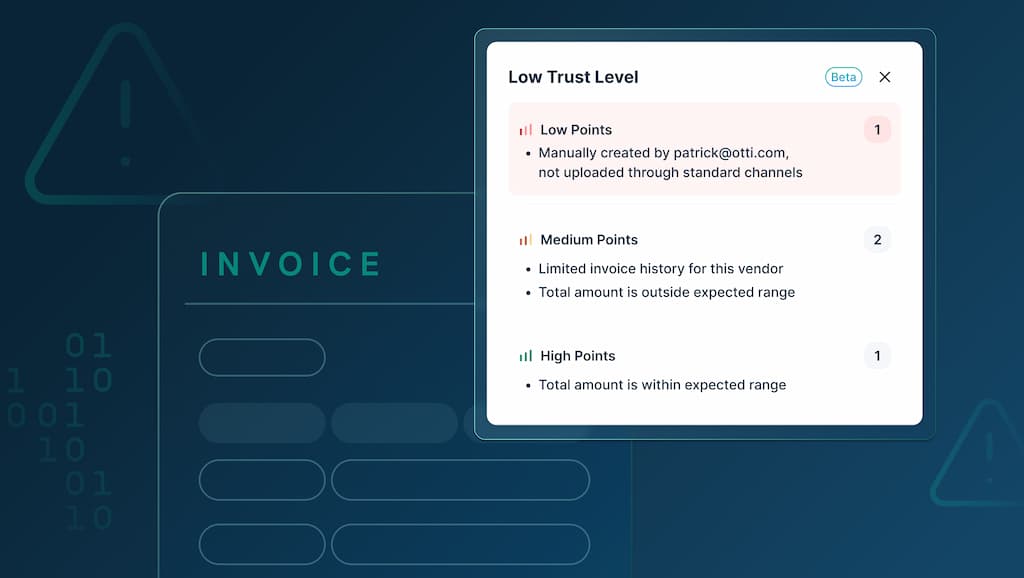
An Invoice Trust Score is an AI-powered risk label that’s assigned to every invoice as it enters the AP system, based on a combination of factors including vendor history, invoice structure, pricing consistency, and timing.
In most systems, invoices receive an invoice trust score ranging from high to low. Invoices from known vendors with amounts and submission behavior that aligns with historical patterns receive high scores. These invoices can continue flowing through the AP process without interruption.
On the other hand, invoices from unknown vendors or those with unexpected formats, pricing, and submission timing may receive low trust scores. These are flagged for human review before they’re pushed further through the process. Flagged invoices are accompanied by the proper context so human reviewers understand the rationale behind every low score. That way, they can focus on what matters and make a judgment call.
While invoice trust scores consider several factors, they highlight the highest-risk signal rather than the average of all signals. In other words, an invoice with just one risky signal, such as an unknown vendor, will still receive a low score, even if all other factors appear routine. This approach helps businesses avoid costly misses.
Invoice risk scoring isn’t a simple duplicate check; a difference we’ll cover in more detail later in this post. It’s also not a static set of rules. Instead, it’’s a dynamic model that’s always learning and adapting to what’s “normal” for your organization and vendors. That means it’s always getting better at accurately detecting anomalies that could indicate fraud.
What does a trust score actually flag?
Invoice trust scores are based on a combination of different factors. Here’s a look at some of the most common types of signals that could trigger a low invoice trust score.
Document-level signals
Invoice trust scoring considers the characteristics of the invoice itself. Handwritten notes, poor legibility, inconsistent formatting, missing fields, and unusual fonts are all examples of document-level signals that could trigger a low score.
Vendor-level signals
Suspicious vendor signals could also trigger a low invoice trust score. This might include modified vendor records, changes to banking details, and vendors that don’t match known supplier lists.
Behavioral signals
An invoice may receive a low score if it exhibits behavior that falls outside of normal patterns for the vendor. For example, if an invoice arrives at an unusual time, with an unexpected amount, or at a frequency that’s outside of the norm for the vendor, it could be flagged.
Anomaly signals
Invoice trust scoring also considers anomalies. For example, an invoice might receive a low trust score if the tax rates are different from the historical norms for that vendor. It could also happen if invoice amounts fall just below approval thresholds, which is a common fraud tactic.
Duplicate signals
The system may also flag invoices that shows signs of duplication This could include matching invoice numbers, similar invoice amounts, or multiple invoices from the same vendor submitted within a short amount of time.
Trust Scores vs. traditional duplicate invoice detection: What’s the difference?
Many finance teams still rely on duplicate invoice detection as their primary defense against fraud and payment errors. Duplicate detection is certainly important. Consider the fact that Ottimate uncovers an average of $1.4M in duplicate invoices per customer per year.
But it’s only one piece of the puzzle.
Traditional duplicate detection looks for exact or near-exact matches among invoices already in the system. That could include repeated invoice numbers, matching amounts, or duplicated submissions from the same vendor. But traditional duplicate detection only gets to work after an invoice has already entered the workflow.
Invoice scoring, on the other hand, determines whether an invoice should be trusted before it ever enters the approval queue. For example, it can flag an invoice that hasn’t been submitted before but shows suspicious signals such as unusual submission timing, odd formatting, or altered vendor details.
At the end of the day, duplicate detection acts as a safety net for invoices that are already in the system. But invoice trust scoring prevents potentially problematic invoices from entering the system in the first place.
How trust scoring changes the AP team’s day-to-day
As the prevalence and sophistication of AI-powered invoice fraud continue to grow, more finance teams are incorporating trust scores into their AP workflows. And those who do see a nearly immediate difference in their day-to-day work.
A recent survey found that manually reviewing invoices is one of the most common frustrations of AP professionals. But with invoice trust scoring in place, teams no longer have to review every single invoice. Instead, they can focus on those that truly require human attention and judgment.
Ottimate data shows 70% of invoices for senior living customers flow from capture to approval-ready with zero manual intervention. Other industries experience similarly high rates, which means they can maintain control with less manual work.
Low-trust invoices get routed for human review. And because there’s rationale attached, reviewers can hone in on what matters and make informed decisions faster.
Adopting invoice trust scoring means finance teams can shift from volume-based review to exception-based control. This approach results in fewer fraudulent payments, and it also supports a more efficient, scalable AP operation. As invoice volume grows, AP teams can maintain control and prevent fraud without adding headcount or introducing delays.
Trust scoring is one layer of a broader invoice fraud detection framework
Uncovering risky invoices plays a powerful role in preventing fraud. But it’s most effective when it’s part of a broader control framework
Trust scoring works upstream by flagging potentially problematic invoices before they move through the workflow. From there, downstream controls help ensure the right actions are taken.
For example, if a suspicious invoice receives a low trust score, it can automatically trigger a structured approval workflow or threshold-based routing. This ensures the right people review the suspicious invoice before payment is approved.
Secure disbursement methods further reduce risk, even after invoices have been approved. For example, single use virtual cards and ACH payments create more controlled, traceable payment flows than traditional payment methods such as paper checks.
Together, these layers add up to a stronger, connected AP workflow that helps organizations prevent risk at every stage of the process.
FAQs
Modern invoice fraud requires modern controls
As AI continues to evolve, invoice fraud is becoming more common and more sophisticated. Yet, many organizations still rely on manual controls that were built for a much simpler risk environment.
AP teams can no longer afford to ignore the growing risk of fraud. They need a modern, multi-faceted approach to decreasing risk.
Invoice trust scoring provides an essential layer of protection by helping teams automatically identify risk before payments are approved and funds are released.
Learn more about how Ottimate helps AP teams automatically detect risk as soon as an invoice arrives. Or, book a demo to see how Ottimate helps organizations maintain stronger AP fraud prevention controls across the entire AP process.