Finance Tech Exhaustion: Why More Tools Aren’t the Answer
by Hannah Khouri
When the finance team is facing a challenge, a common first instinct is to look for a tool to address it. Spending too much time on invoice intake? Invest in optical character recognition (OCR). Approvals dragging you down? There’s a tool built just for that.
Teams enter these purchases with high hopes of greater efficiency. But over time, they’re left with a bad case of tech exhaustion instead.
Often, finance teams have tools, alerts, and dashboards coming at them from all angles. They’re meant to make life easier. But instead, they leave teams feeling overwhelmed by disconnected systems, duplicate work, and unreliable data.
More tools don’t mean better outcomes. What finance teams really need is smarter, more connected intelligence.
What is tech exhaustion in finance teams?
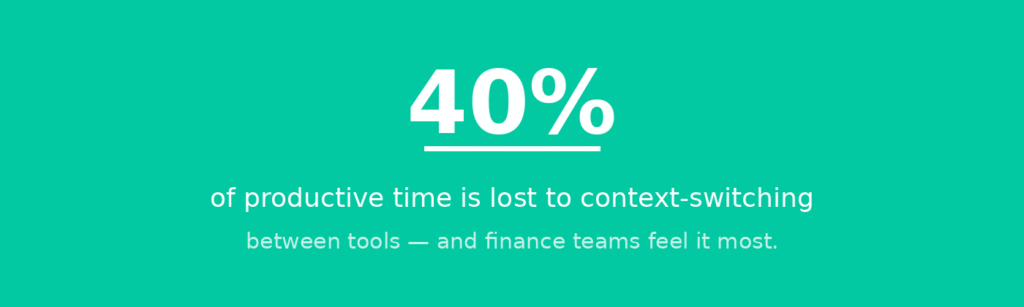
Context shifting, which is the act of moving from one task or tool to another before finishing the first, takes a major toll on productivity. One study found that switching between tasks can account for up to 40% of a person’s productive time.
Yet it’s something finance teams find themselves doing a lot.
Today’s finance teams have a whole collection of tools they’re expected to juggle, including ERPs, AP, payment, Slack, and reporting tools, among others. They get started on a task in one tool, only to get distracted by an alert in another. A study found that over half of employees feel the need to address notifications immediately – whether or not they’re truly urgent.
To make matters worse, these tools often poorly communicate with one another. That means stretched teams have to waste their time on duplicate work and manual reconciliation between disconnected tools. And they’re never completely confident in the data.
Over time, tech exhaustion chips away at morale. Finance teams find themselves burned out, slowed down, and forever stuck in reactive mode.
Why finance teams end up with too many tools
Research tells us that most employees are overwhelmed by the number of tools they’re expected to use. Finance professionals are no exception.
But how did we get to this point?
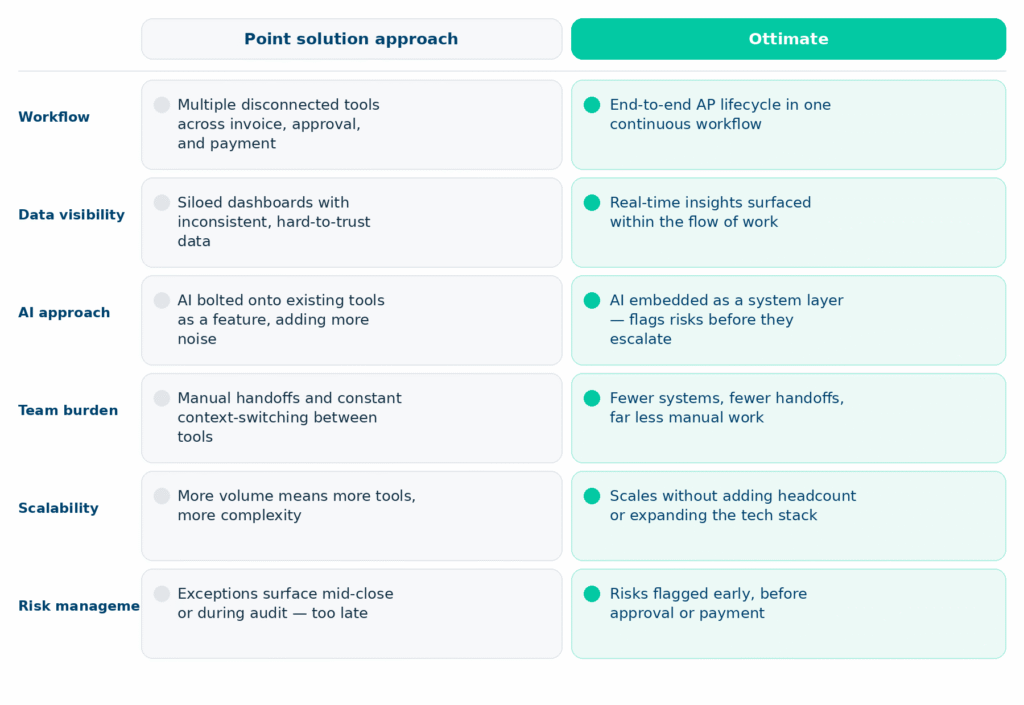
In the past decade, there’s been an explosion of specialized finance tools entering the market. These “best in class” tools may excel at solving a single, narrow problem. But when you pile one on top of another, you end up with system sprawl. Laying AI onto these fragmented systems only makes matters worse.
Finance teams invest in point solutions to make their lives easier. But this all-too-common approach creates more complexity than it eliminates.
Why adding more finance tools makes things worse
Adding another promising tool to your tech stack might seem like the answer. But piling on more technology only adds to the problem.
When finance tech stacks are disconnected, tools operate in silos. Tools don’t talk to each other, so important context doesn’t carry over from one to the next.
There’s also a data problem. Each tool comes equipped with its own reporting and analytics, so teams have plenty of data at their disposal. But because it’s disconnected (and teams don’t always place much trust in it), it’s nearly impossible to identify actionable insight.
Adding automation might seem like a great way to address inefficiency. But automation without intelligence still requires manual oversight. Finance teams act as system managers, overseeing handoffs from one tool to the next, when they really should be serving as strategic operators.
How to move from a disconnected tech stack to a unified finance system
Organizations are realizing that disconnected tool stacks create unnecessary complexity and overwhelm teams that are already stretched thin. That’s why we’re seeing a notable shift from tool stacks to intelligent finance systems.
The point isn’t to slash tools in the name of simplicity. It’s to take an honest look at how well these tools work together (if they work together at all). Instead of aiming for fewer tools, shoot for less friction and more clarity in your process.
This is where a more unified, intelligent approach starts to matter.
Instead of stitching together point solutions and manually connecting the dots, leading teams are moving to systems that unify the entire workflow. Data is no longer stuck in isolated dashboards. Instead, it flows through the entire process, carrying context with it.
Most importantly, intelligence isn’t an afterthought. It’s embedded within the workflow itself.
The shift to intelligent systems is transforming the way finance teams work. Teams can move from reacting to issues after the fact to proactively preventing problems from happening in the first place. Fragmented processes give way to a more unified, continuous view of the AP lifecycle. And disconnected, unreliable data transforms into clear, trustworthy insights that enable smarter, more confident decision-making.
What finance teams actually need instead of more tools
Finance teams don’t need another point tool. Most are already overwhelmed by too many.
So what do they actually need? An intelligent system that reduces friction, surfaces insights in real-time, and supports better, more timely decision-making. Here’s a closer look at what that looks like.
Context-aware insights
Finance teams have no shortage of data. Teams need to be able to surface insights within the context of work itself, highlighting risks and opportunities as they emerge.
Intelligence that’s embedded in workflows
When intelligence lives in a separate tool, it creates yet another disconnected step and an opportunity for teams to focus. A modern system brings intelligence into the process so teams can act without switching contexts or cobbling together data from multiple sources.
Signal over noise
When teams use multiple point tools, they’re often inundated with alerts and have little insight into which are truly a priority. When everything feels like a priority, nothing gets done. Modern finance teams need systems that surface the right information at the right time, with clear guidance on what requires attention.
End-to-end visibility across the AP lifecycle
Finance teams need real-time, connected visibility into what’s happening, from invoice intake to payment. But when tools are disconnected, issues stay hidden until they become bigger problems, and decisions are made without the full context.
Systems that learn and adapt over time
Static rules and rigid workflows quickly become outdated. Modern finance teams need intelligent systems that learn from patterns, adapt to changing conditions, and continuously improve how work gets done – no manual intervention required.
How AI should work in a finance tech stack
Increasingly, finance teams are turning to AI to streamline operations. Whether it actually helps depends on how AI is used.
By now, many finance platforms tout AI as a feature. It’s a smarter dashboard or a faster report. But what we’re seeing here is AI bolted onto an already existing tool.
When teams use AI as a feature, it means they have more places to do work and more noise to contend with. In an already fragmented environment, AI as a feature only adds to the overwhelm.
The teams that are successfully reducing complexity are the ones that use AI as a system layer. AI is embedded in workflows, not sitting on top of them. This approach eliminates manual analysis, surfaces risks early, and recommends next steps, all within the flow of work. There’s no need to switch between tools.
The bottom line is that AI layered on top of fragmented tools leads to even more tech exhaustion. But AI that’s built into a unified system reduces complexity and makes life much easier for finance teams.
How Ottimate solves tech exhaustion for burned-out finance teams
At this point, one thing is crystal clear: adding yet another finance tool won’t solve the problem of tech exhaustion. To truly address it, organizations must rethink the way work is done.
Ottimate is a true unified AP platform, not another point solution to add to your growing collection. Instead of forcing teams to switch between tools all day long, it brings the entire AP lifecycle together in one continuous workflow, from invoice intake to payment. And most importantly, intelligence is built right into that workflow, not bolted on as an afterthought.
Ottimate surfaces insights in real time, right within the flow of work. There’s no need to switch to a different tool. And because insights are surfaced in real time, teams can proactively identify risks early and take action before they spiral into bigger problems.
Finance teams are exhausted by tools, dashboards, and alerts, with manual work holding it all together. With Ottimate, they finally have fewer systems to manage, fewer manual handoffs, and far less noise. That means they can spend less time chasing down invoices and managing handoffs between disconnected tools, and more time analyzing data and making impactful decisions that move the business forward.
Real impact: what changes for finance teams
When organizations shift from overgrown tech stacks to unified systems, the impact can be felt across the entire finance team.
Teams are no longer chasing data across disconnected tools or trying to figure out how to act on it. Instead, they have a single, reliable source of truth. They can access and act on insights right within the flow of work – no context switching needed.
In this environment, work shifts from reactive firefighting to proactive control. Risks are flagged earlier so they can be addressed before they escalate.
Teams are no longer stuck navigating endless tools, alerts, and manual processes. Instead, they have a clearer, more focused way of working and more time to drive business outcomes.
This shift means work can move faster. But just as important, it means teams feel a lot less overwhelmed. They can be more strategic, more confident, and better equipped to support the business, without being weighed down by disconnected tools and dashboards.
The future of finance is simplicity
Finance doesn’t need more technology. Most teams are already overwhelmed by all the tools they’re expected to use.
Instead, they need better orchestration of technology. When systems are connected and intelligence is built in, teams have more clarity and can make decisions faster and with greater confidence.
Finance leaders must ask an important question: “Is our tech stack creating leverage or leading to exhaustion?” If it’s the latter, it’s time to rethink the way work is done.
FAQ
Is your team feeling the weight of too many tools?
Find out why more companies are trading disconnected tech stacks for a unified, intelligent AP system. Book your demo to see how Ottimate can transform the way your finance team works.